|
Electronic Components Datasheet Search |
|
|
Electronic Components Datasheet Search |
|
AD7468BRT-R Datasheet(PDF) 21 Page - Analog Devices |
|
|
|||||||||||||||||||||||||||||
AD7468BRT-R Datasheet(HTML) 21 Page - Analog Devices |
|
|
21 / 28 page 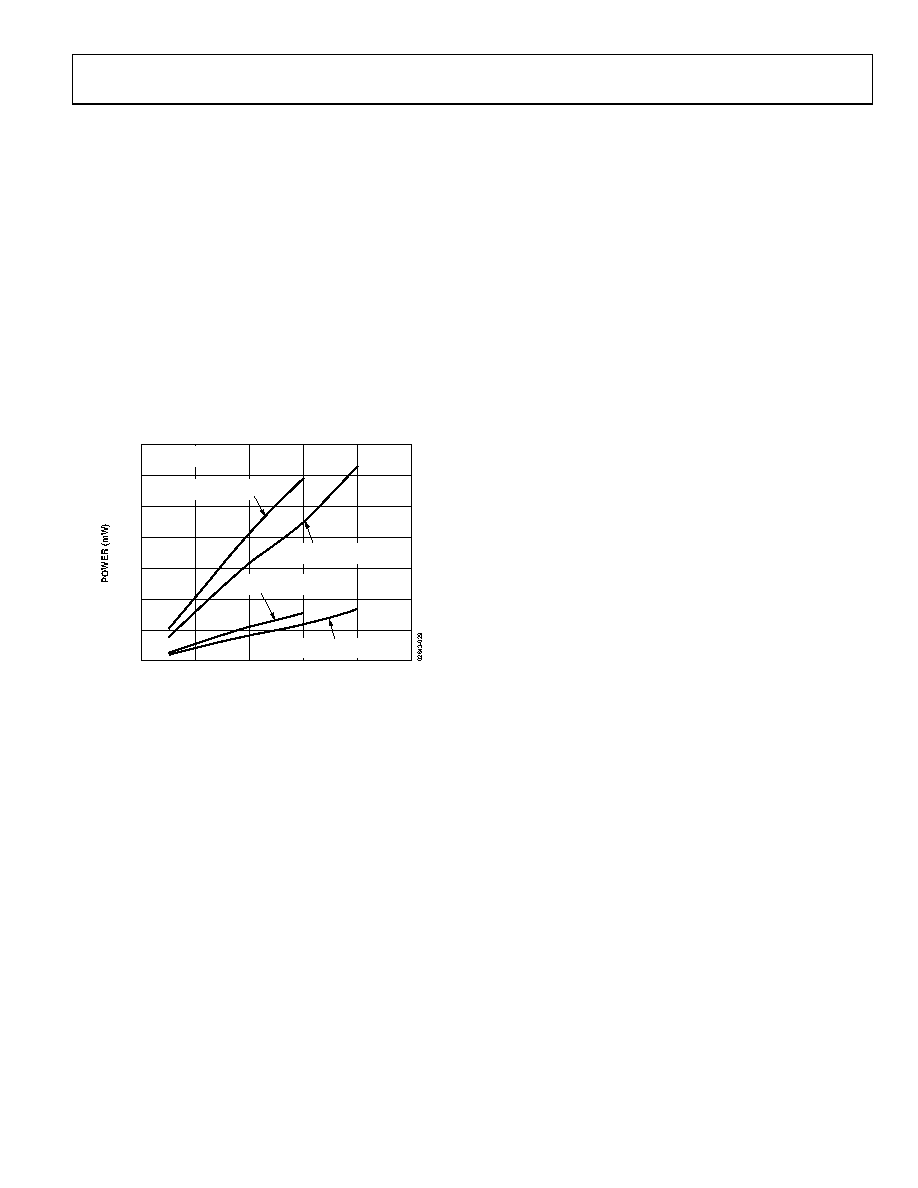 AD7466/AD7467/AD7468 Rev. C | Page 21 of 28 Figure 18 shows power consumption vs. throughput rate for a 3.4 MHz SCLK frequency. In this case, the conversion time is the same for all cases because the SCLK frequency is a fixed parameter. Low throughput rates lead to lower current con- sumptions, with a higher percentage of the time in power-down mode. Figure 27 shows two AD7466s running with the same SCLK frequency, but at different throughput rates. The A throughput rate is higher than the B throughput rate. The slower the throughput rate, the longer the period of time the part is in power-down mode, and the average power consump- tion drops accordingly. Figure 28 shows the power vs. throughput rate for different supply voltages and SCLK frequencies. For this plot, all the elements regarding power consumption that were explained previously (the influence of the SCLK frequency, the influence of the throughput rate, and the influence of the supply voltage) are taken into consideration. 1.4 0.2 0.4 0.6 0.8 1.0 1.2 0 0 50 100 150 200 250 THROUGHPUT (kSPS) TEMP = 25 °C VDD = 3.0V, SCLK = 2.4MHz VDD = 3.0V, SCLK = 3.4MHz VDD = 1.8V, SCLK = 2.4MHz VDD = 1.8V, SCLK = 3.4MHz Figure 28. Power vs. Throughput Rate for Different SCLK and Supply Voltages The following examples show calculations for the information in this section. Power Consumption Example 1 This example shows that, for a fixed throughput rate, as the SCLK frequency increases, the average power consumption drops. From Figure 26, for SCLK A = 3.4 MHz, SCLK B = 1.2 MHz, and a throughput rate of 50 kSPS, which gives a cycle time of 20 μs, the following values can be obtained: Conversion Time A = 16 × (1/SCLK A) = 4.7 μs (23.5% of the cycle time) Power-Down Time A = (1/Throughput) − Conversion Time A = 20 μs − 4.7 μs = 15.3 μs (76.5% of the cycle time) Conversion Time B = 16 × (1/SCLK B) = 13 μs (65% of the cycle time) Power-Down Time B = (1/Throughput) − Conversion Time B = 20 μs − 13 μs = 7 μs (35% of the cycle time) The average power consumption includes the power dissipated when the part is converting and the power dissipated when the part is in power-down mode. The average power dissipated during conversion is calculated as the percentage of the cycle time spent when converting, multiplied by the maximum current during conversion. The average power dissipated in power-down mode is calculated as the percentage of cycle time spent in power-down mode, multiplied by the current figure for power-down mode. In order to obtain the value for the average power, these terms must be multiplied by the voltage. Considering the maximum current for each SCLK frequency for VDD = 1.8 V, Power Consumption A = ((4.7/20) × 186 μA + (15.3/20) × 100 nA) × 1.8 V = (43.71 + 0.076) μA × 1.8 V = 78.8 μW = 0.07 mW Power Consumption B = ((13/20) × 108 μA + (7/20) × 100 nA) × 1.8 V = (70.2 + 0.035) μA × 1.8 V = 126.42 μW = 0.126 mW It can be concluded that for a fixed throughput rate, the average power consumption drops as the SCLK frequency increases. Power Consumption Example 2 This example shows that, for a fixed SCLK frequency, as the throughput rate decreases, the average power consumption drops. From Figure 27, for SCLK = 3.4 MHz, Throughput A = 100 kSPS (which gives a cycle time of 10 μs), and Throughput B = 50 kSPS (which gives a cycle time of 20 μs), the following values can be obtained: Conversion Time A = 16 × (1/SCLK) = 4.7 μs (47% of the cycle time for a throughput of 100 kSPS) Power-Down Time A = (1/Throughput A) − Conversion Time A = 10 μs − 4.7 μs = 5.3 μs (53% of the cycle time) Conversion Time B = 16 × (1/SCLK) = 4.7 μs (23.5% of the cycle time for a throughput of 50 kSPS) Power-Down Time B = (1/Throughput B) − Conversion Time B = 20 μs − 4.7 μs = 15.3 μs (76.5% of the cycle time) The average power consumption is calculated as explained in Power Consumption Example 1, considering the maximum current for a 3.4 MHz SCLK frequency for VDD = 1.8 V. Power Consumption A = ((4.7/10) × 186 μA + (5.3/10) × 100 nA) × 1.8 V= (87.42 + 0.053) μA × 1.8 V = 157.4 μW = 0.157 mW Power Consumption B = ((4.7/20) × 186 μA + (15.3/20) × 100 nA) × 1.8 V = (43.7 + 0.076) μA × 1.8 V = 78.79 μW = 0.078 mW It can be concluded that for a fixed SCLK frequency, the average power consumption drops as the throughput rate decreases. |
|
Link URL |
| Does ALLDATASHEET help your business so far? [ DONATE ] |
About Alldatasheet | Advertisement | Contact us | Privacy Policy | Link to Datasheet | Link Exchange | Manufacturer List All Rights Reserved©Alldatasheet.com |
| Russian : Alldatasheetru.com | Korean : Alldatasheet.co.kr | Spanish : Alldatasheet.es | French : Alldatasheet.fr | Italian : Alldatasheetit.com Portuguese : Alldatasheetpt.com | Polish : Alldatasheet.pl | Vietnamese : Alldatasheet.vn Indian : Alldatasheet.in | Mexican : Alldatasheet.com.mx | British : Alldatasheet.co.uk | New Zealand : Alldatasheet.co.nz |
|
Family Site : ic2ic.com |
icmetro.com |
 Indian ▼
 English
 Chinese
 German
 Japanese
 Russian
 Korean
 Spanish
 French
 Italian
 Portuguese
 Polish
 Vietnamese
 Indian
 Mexican
 British
 New Zealand