 |
Electronic Components Datasheet Search |
|
|
Electronic Components Datasheet Search |
|
The question interval is too short.
Please try again in a few seconds.

Hello, Please ask a question about RF2369PCBA-41X Datasheet
# Example questions:
➢ What are the typical vcc voltage ranges for optimal performance in both high gain and bypass modes for the cellular lna, according to the provided graphs?
➢ What is the status of the material content regarding the banned substances (pb, cd, hg, cr vi, pbb, pbde)?
➢ What are the key performance differences (e.g., gain, iip3) between the high gain and bypass modes of the cellular lna?
| Part No. | RF2369PCBA-41X |
| Manufacturer | RFMD |
| Size | 408 Kbytes |
| Pages | 12 pages |
| Description | 3V LOW NOISE AMPLIFIER/ 3V PA DRIVER AMPLIFIER |





1. Device Overview:
️· Type: RF LNA (Low Noise Amplifier). It's designed for cellular applications.
️· Key Features: Offers both High Gain and Bypass modes.
️· Operating Frequency: The graphs and plots suggest operation in the cellular bands (likely around 800 MHz - 2 GHz, but this is not explicitly stated).
2. Performance Characteristics (Key Specs):
️· Gain: Varies based on mode and supply voltage (Vcc). High Gain mode offers significantly higher gain (around 14-17dB).
️· Noise Figure: The noise figure in High Gain mode is a critical performance indicator, being around 2.5dB.
️· IIP3 (Third-Order Intercept Point): IIP3 is a measure of linearity. Values provided in graphs suggest good linearity, particularly in High Gain mode.
️· Total Current Consumption (Icc): Icc varies depending on mode and Vcc.
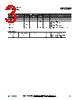
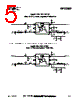
️· S-Parameters (S11, S22): Charts are provided showcasing S11 (return loss) and S22 (transmission loss) in both High Gain and Bypass modes. These indicate how well the device is matched to the impedance and how much signal passes through.
3. Operating Conditions & Control:
️· Supply Voltage (Vcc): Performance is heavily influenced by Vcc. The datasheet includes graphs demonstrating the impact of Vcc on Gain, Noise Figure, IIP3, and current consumption.
️· Modes:
- High Gain Mode: Provides amplification.
- Bypass Mode: Offers a direct signal path with lower gain, and may be used for testing or to switch off amplification.
4. Physical Characteristics:
️· Package: Not specifically detailed, but it's a small surface-mount package.
️· Weight: 0.013 grams.
5. Regulatory Compliance:
️· RoHS Compliant: Yes, meets the Restriction of Hazardous Substances directive.
️· Materials Declaration: A detailed Bill of Materials (BOM) is provided, listing restricted substances (Pb, Cd, Hg, Cr VI, PBB, PBDE) and their concentrations in each component.
6. Graphs and Charts:
The document heavily relies on graphs to illustrate performance characteristics as functions of Vcc and temperature. These graphs cover:
️· Gain vs. Vcc
️· Noise Figure vs. Vcc
️· IIP3 vs. Vcc
️· Total Current Consumption vs. Vcc
️· S-Parameter performance in both modes.
In essence, this datasheet provides the technical specifications and performance characteristics needed to integrate the RF2369 LNA into a cellular communication system. It’s geared toward RF engineers and designers.
1. Device Overview:
️· Type: RF LNA (Low Noise Amplifier). It's designed for cellular applications.
️· Key Features: Offers both High Gain and Bypass modes.
️· Operating Frequency: The graphs and plots suggest operation in the cellular bands (likely around 800 MHz - 2 GHz, but this is not explicitly stated).
2. Performance Characteristics (Key Specs):
️· Gain: Varies based on mode and supply voltage (Vcc). High Gain mode offers significantly higher gain (around 14-17dB).
️· Noise Figure: The noise figure in High Gain mode is a critical performance indicator, being around 2.5dB.
️· IIP3 (Third-Order Intercept Point): IIP3 is a measure of linearity. Values provided in graphs suggest good linearity, particularly in High Gain mode.
️· Total Current Consumption (Icc): Icc varies depending on mode and Vcc.
️· S-Parameters (S11, S22): Charts are provided showcasing S11 (return loss) and S22 (transmission loss) in both High Gain and Bypass modes. These indicate how well the device is matched to the impedance and how much signal passes through.
3. Operating Conditions & Control:
️· Supply Voltage (Vcc): Performance is heavily influenced by Vcc. The datasheet includes graphs demonstrating the impact of Vcc on Gain, Noise Figure, IIP3, and current consumption.
️· Modes:
- High Gain Mode: Provides amplification.
- Bypass Mode: Offers a direct signal path with lower gain, and may be used for testing or to switch off amplification.
4. Physical Characteristics:
️· Package: Not specifically detailed, but it's a small surface-mount package.
️· Weight: 0.013 grams.
5. Regulatory Compliance:
️· RoHS Compliant: Yes, meets the Restriction of Hazardous Substances directive.
️· Materials Declaration: A detailed Bill of Materials (BOM) is provided, listing restricted substances (Pb, Cd, Hg, Cr VI, PBB, PBDE) and their concentrations in each component.
6. Graphs and Charts:
The document heavily relies on graphs to illustrate performance characteristics as functions of Vcc and temperature. These graphs cover:
️· Gain vs. Vcc
️· Noise Figure vs. Vcc
️· IIP3 vs. Vcc
️· Total Current Consumption vs. Vcc
️· S-Parameter performance in both modes.
In essence, this datasheet provides the technical specifications and performance characteristics needed to integrate the RF2369 LNA into a cellular communication system. It’s geared toward RF engineers and designers.
| Part No. | RF2369PCBA-41X |
| Manufacturer | RFMD |
| Size | 408 Kbytes |
| Pages | 12 pages |
| Description | 3V LOW NOISE AMPLIFIER/ 3V PA DRIVER AMPLIFIER |
| Does ALLDATASHEET help your business so far? [ DONATE ] |
About Alldatasheet | Advertisement | Contact us | Privacy Policy | Link to Datasheet | Link Exchange | Manufacturer List All Rights Reserved©Alldatasheet.com |
| Russian : Alldatasheetru.com | Korean : Alldatasheet.co.kr | Spanish : Alldatasheet.es | French : Alldatasheet.fr | Italian : Alldatasheetit.com Portuguese : Alldatasheetpt.com | Polish : Alldatasheet.pl | Vietnamese : Alldatasheet.vn Indian : Alldatasheet.in | Mexican : Alldatasheet.com.mx | British : Alldatasheet.co.uk | New Zealand : Alldatasheet.co.nz |
|
Family Site : ic2ic.com |
icmetro.com |
 Indian ▼
  English
 Chinese
 German
 Japanese
 Russian
 Korean
 Spanish
 French
 Italian
 Portuguese
 Polish
 Vietnamese
 Mexican
 British
 New Zealand