 |
Electronic Components Datasheet Search |
|
|
Electronic Components Datasheet Search |
|
The question interval is too short.
Please try again in a few seconds.

Hello, Please ask a question about CS5124 Datasheet
# Example questions:
➢ Describe the interaction between the uvlo pin and the thermal shutdown circuit, particularly regarding potential changes in the uvlo turn-on threshold at higher temperatures.
➢ What is the primary function of the 'second threshold comparator' and what happens when its threshold is exceeded?
➢ Explain how the clock synchronization pin (cs5126 only) affects the maximum duty cycle and how it operates.
| Part No. | CS5124 |
| Manufacturer | CHERRY |
| Size | 172 Kbytes |
| Pages | 10 pages |
| Description | High Performance, Integrated Current Mode PWM Controllers |





1. Device Overview:
️· CS5124 vs. CS5126: These are switching regulators with some key differences (frequency, synchronization capabilities).
️· Applications: These regulators are likely intended for isolated power supplies, flyback converters, or similar applications.
2. Key Features & Specifications:
️· Operating Frequency:
- CS5124: 400 kHz
- CS5126: 200 kHz
️· Synchronization (CS5126 Only): The CS5126 can be synchronized to external clock signals, allowing for precise control of switching frequency. It can handle signals slower or faster than its internal frequency (up to several times faster).
️· Under Voltage Lockout (UVLO): Protects the system by shutting down if the input voltage is too low (below 2.6V for activation, and shutdown at around 1.8V).
️· Thermal Shutdown: Protects the device from overheating (shutdown around 150°C junction temperature, with hysteresis).
️· VREF(OK) Monitor: Internal monitor to ensure the reference voltage is stable before switching begins.
️· Second Current Threshold: A safety feature that shuts down the output if the current exceeds a predetermined level (195mV for CS5124, 275mV for CS5126). This is to protect against short circuits or excessive load conditions.
️· VFB Comparator: Shuts down the output if the feedback voltage is too low, preventing overvoltage conditions.
️· Slope Compensation: Provides stability to the feedback loop.
- CS5124: 170mV/µs (effective 21mV/µs)
- CS5126: 125mV/µs (effective 18mV/µs)
️· Gate Drive: Supports rail-to-rail gate drive capability.
️· BIAS Pin (CS5124 Only): Used to control VCC, important for line regulation.
3. Operational Details:
️· Soft Start: Controlled capacitor charging sequence to limit inrush current during startup.
️· Clock Synchronization (CS5126): Positive-edge triggered synchronization.
️· Gate Drive: Rail-to-rail gate drive capability is achievable with appropriate gate resistors.
️· UVLO Interaction with Thermal Shutdown: Hysteresis of the UVLO circuit increases with temperature.
4. Application Information and Recommendations:
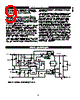
️· BIAS Pin (CS5124): Maintain the pole frequency created by the series pass transistor and VCC bypass capacitor above 10kHz for optimal line regulation.
️· Synchronization: Maximum duty cycle is reduced when synchronized to faster-than-internal clock signals.
️· Gate Drive: Keep gate resistors low for rail-to-rail gate drive.
️· Layout Considerations: Proper layout is critical for stability and performance (not explicitly detailed, but implied).
In essence, this document provides a detailed technical guide to using these regulators, outlining their operation, protective features, and application considerations. It's geared towards engineers designing power supplies incorporating these integrated circuits.
1. Device Overview:
️· CS5124 vs. CS5126: These are switching regulators with some key differences (frequency, synchronization capabilities).
️· Applications: These regulators are likely intended for isolated power supplies, flyback converters, or similar applications.
2. Key Features & Specifications:
️· Operating Frequency:
- CS5124: 400 kHz
- CS5126: 200 kHz
️· Synchronization (CS5126 Only): The CS5126 can be synchronized to external clock signals, allowing for precise control of switching frequency. It can handle signals slower or faster than its internal frequency (up to several times faster).
️· Under Voltage Lockout (UVLO): Protects the system by shutting down if the input voltage is too low (below 2.6V for activation, and shutdown at around 1.8V).
️· Thermal Shutdown: Protects the device from overheating (shutdown around 150°C junction temperature, with hysteresis).
️· VREF(OK) Monitor: Internal monitor to ensure the reference voltage is stable before switching begins.
️· Second Current Threshold: A safety feature that shuts down the output if the current exceeds a predetermined level (195mV for CS5124, 275mV for CS5126). This is to protect against short circuits or excessive load conditions.
️· VFB Comparator: Shuts down the output if the feedback voltage is too low, preventing overvoltage conditions.
️· Slope Compensation: Provides stability to the feedback loop.
- CS5124: 170mV/µs (effective 21mV/µs)
- CS5126: 125mV/µs (effective 18mV/µs)
️· Gate Drive: Supports rail-to-rail gate drive capability.
️· BIAS Pin (CS5124 Only): Used to control VCC, important for line regulation.
3. Operational Details:
️· Soft Start: Controlled capacitor charging sequence to limit inrush current during startup.
️· Clock Synchronization (CS5126): Positive-edge triggered synchronization.
️· Gate Drive: Rail-to-rail gate drive capability is achievable with appropriate gate resistors.
️· UVLO Interaction with Thermal Shutdown: Hysteresis of the UVLO circuit increases with temperature.
4. Application Information and Recommendations:
️· BIAS Pin (CS5124): Maintain the pole frequency created by the series pass transistor and VCC bypass capacitor above 10kHz for optimal line regulation.
️· Synchronization: Maximum duty cycle is reduced when synchronized to faster-than-internal clock signals.
️· Gate Drive: Keep gate resistors low for rail-to-rail gate drive.
️· Layout Considerations: Proper layout is critical for stability and performance (not explicitly detailed, but implied).
In essence, this document provides a detailed technical guide to using these regulators, outlining their operation, protective features, and application considerations. It's geared towards engineers designing power supplies incorporating these integrated circuits.
| Part No. | CS5124 |
| Manufacturer | CHERRY |
| Size | 172 Kbytes |
| Pages | 10 pages |
| Description | High Performance, Integrated Current Mode PWM Controllers |
| Does ALLDATASHEET help your business so far? [ DONATE ] |
About Alldatasheet | Advertisement | Contact us | Privacy Policy | Link to Datasheet | Link Exchange | Manufacturer List All Rights Reserved©Alldatasheet.com |
| Russian : Alldatasheetru.com | Korean : Alldatasheet.co.kr | Spanish : Alldatasheet.es | French : Alldatasheet.fr | Italian : Alldatasheetit.com Portuguese : Alldatasheetpt.com | Polish : Alldatasheet.pl | Vietnamese : Alldatasheet.vn Indian : Alldatasheet.in | Mexican : Alldatasheet.com.mx | British : Alldatasheet.co.uk | New Zealand : Alldatasheet.co.nz |
|
Family Site : ic2ic.com |
icmetro.com |
 Indian ▼
  English
 Chinese
 German
 Japanese
 Russian
 Korean
 Spanish
 French
 Italian
 Portuguese
 Polish
 Vietnamese
 Mexican
 British
 New Zealand