|
Electronic Components Datasheet Search |
|
|
Electronic Components Datasheet Search |
|
EM342-RTR Datasheet(PDF) 25 Page - Silicon Laboratories |
|
|
|||||||||||||||||||||||||||||
EM342-RTR Datasheet(HTML) 25 Page - Silicon Laboratories |
|
|
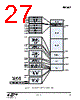
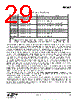
25 / 143 page  EM342 Rev 1.0 25 4.4. Integrated MAC Module The EM342 integrates most of the IEEE 802.15.4-2003 MAC requirements in hardware. This allows the ARM® CortexTM-M3 CPU to provide greater bandwidth to application and network operations. In addition, the hardware acts as a first-line filter for unwanted packets. The EM342 MAC uses a DMA interface to RAM to further reduce the overall ARM® CortexTM-M3 CPU interaction when transmitting or receiving packets. When a packet is ready for transmission, the Ember software configures the TX MAC DMA by indicating the packet buffer RAM location. The MAC waits for the backoff period, then switches the baseband to TX mode and performs channel assessment. When the channel is clear the MAC reads data from the RAM buffer, calculates the CRC, and provides 4-bit symbols to the baseband. When the final byte has been read and sent to the baseband, the CRC remainder is read and transmitted. The MAC is in RX mode most of the time. In RX mode various format and address filters keep unwanted packets from using excessive RAM buffers, and prevent the CPU from being unnecessarily interrupted. When the reception of a packet begins, the MAC reads 4-bit symbols from the baseband and calculates the CRC. It then assembles the received data for storage in a RAM buffer. RX MAC DMA provides direct access to RAM. Once the packet has been received additional data, which provides statistical information on the packet to the Ember software, is appended to the end of the packet in the RAM buffer space. The primary features of the MAC are as follows: CRC generation, appending, and checking Hardware timers and interrupts to achieve the MAC symbol timing Automatic preamble and SFD pre-pending on TX packets Address recognition and packet filtering on RX packets Automatic acknowledgment transmission Automatic transmission of packets from memory Automatic transmission after backoff time if channel is clear (CCA) Automatic acknowledgment checking Time stamping received and transmitted messages Attaching packet information to received packets (LQI, RSSI, gain, time stamp, and packet status) IEEE 802.15.4-2003 timing and slotted/unslotted timing 4.5. Packet Trace Interface (PTI) The EM342 integrates a true PHY-level PTI for effective network-level debugging. It monitors all the PHY TX and RX packets between the MAC and baseband modules without affecting their normal operation. It cannot be used to inject packets into the PHY/MAC interface. This 500 kbps asynchronous interface comprises the frame signal (PTI_EN, PA4) and the data signal (PTI_DATA, PA5). PTI is supported by the Ember development tools. 4.6. Random Number Generator Thermal noise in the analog circuitry is digitized to provide entropy for a true random number generator (TRNG). The TRNG produces 16-bit uniformly distributed numbers. The Ember software uses the TRNG to seed a pseudo random number generator (PRNG). The TRNG is also used directly for cryptographic key generation. |
|
Link URL |
| Does ALLDATASHEET help your business so far? [ DONATE ] |
About Alldatasheet | Advertisement | Contact us | Privacy Policy | Link to Datasheet | Link Exchange | Manufacturer List All Rights Reserved©Alldatasheet.com |
| Russian : Alldatasheetru.com | Korean : Alldatasheet.co.kr | Spanish : Alldatasheet.es | French : Alldatasheet.fr | Italian : Alldatasheetit.com Portuguese : Alldatasheetpt.com | Polish : Alldatasheet.pl | Vietnamese : Alldatasheet.vn Indian : Alldatasheet.in | Mexican : Alldatasheet.com.mx | British : Alldatasheet.co.uk | New Zealand : Alldatasheet.co.nz |
|
Family Site : ic2ic.com |
icmetro.com |
 Indian ▼
 English
 Chinese
 German
 Japanese
 Russian
 Korean
 Spanish
 French
 Italian
 Portuguese
 Polish
 Vietnamese
 Indian
 Mexican
 British
 New Zealand